
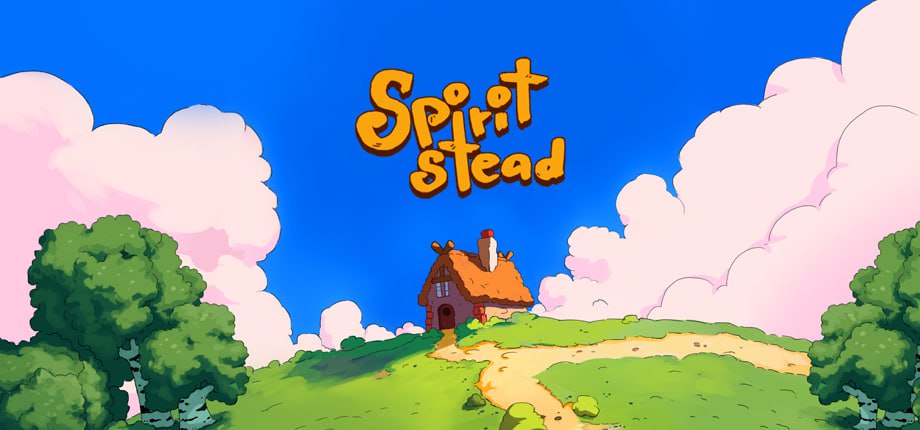

Spiritstead was, unlike what you would really expect from a cozy game, a bit of a rollercoaster for me. Luckily I enjoy rollercoasters. If you prefer slow rides, you can take your time and it’ll be a slow rollercoaster instead: it has a tightly-designed sense of momentum, it twists and turns in places to keep things fresh, and it shows you a few neat sights before finishing. Spiritstead‘s balance isn’t perfect, and it’s not the longest or most complex game, but it’s wholesome, doesn’t overstay its welcome, and you always feel you have plenty to do.

At first I booted it up, and didn’t get through the tutorial because I hadn’t realised it was an idle/incremental game, which I generally dislike. As in most games in the genre, you start by waiting a lot to click on a production tile to collect its resource and repeating, which had me a bit grumpy so I left it. Eventually I came back with a can-do attitude, skipping the tutorial and just getting right to it, micro-ing everything left and right like an RTS game. Though still slow at the start, this kept the momentum up, although I did still find myself wishing for a speed-up button. There’s something to be said about the level of polish, too, with there being no sound or visual indicator/effect that a task has completed (at least on my build of the game), with the resource just appearing and needing to be clicked on.
This meant I had to keep my eyes peeled, and it gave the game feel a micromanagement-y vibe. It quickly turned from boring beginnings to stressful straining, trying keep on top of everything as the game kept levelling me up seemingly every minute, with new buildings to add, and resources to collect, and villagers to send to the outhouse and spirits to – oh, what’s that? Yes, a spirit! A helper that can collect resources for me: it is an idler after all. Well, even with that, the tense momentum remained, though now the click-to-collect loop was replaced by me struggling to position my buildings nicely in the confines of my smallish, hard-to-expand (for the time being) territory, which did give some sauce to the citybuilding side as I had to make some decisions about my town layout.

I managed to settle into this upbeat sort of rhythm and found a coziness in the chaos. Spiritstead proved good at keeping me on my toes, however, as it being so full of varied features meant I could never fully take the edge off. None of the elements of the game are really anything to marvel at individually, but you cycle through them quickly. Minigames, doing the objectives, juggling the various resources and currency types, and collecting the spirits always meant multiple things needing to be taken care of. Quite a lot now, if you add those to the previous list of things to do, which only increased in complexity with time, seeing new types of buildings, and denizens, and places to drag them: besides the outhouse, now the hospital, or back to the log-cutting station where you’re actually supposed to be Cale why did you wander off over there again—!
Anyway. That collecting of spirits that I mentioned. This is the highlight of the game for me, as they are a charming bit of game design, simple but fun (and cute to boot). To unlock a spirit you need to complete a single action, usually something strange and out of the way of main progression, like tossing someone into the sky (which, finding it was a surprise in and of itself, this being a top-down game!) You have a book full of spirits, with a cryptic hint for what the required action is for each one. You can give up some resources for a slightly better hint, then give over much more for the answer – this player-attuned difficulty kept the spirit unlocking fair and fun.

In the latter half of the game, unlocking spirits became the main part of the game rather than a just-for-fun bunch of sidequests due to the way the resource flows kept changing. I do wish the spirits were a bit more varied gameplay-wise, as only a handful of them play a unique role like picking certain things up for you, while all the rest are relegated to resource collection. But at least this did have the amusing consequence of spirits getting sent straight to the mines the second they’re obtained. Hey, no room for lolly-gaggers on mah spiritstead…
The game is not balanced perfectly, and while still fun and far from being totally broken, this did leave a bit of an empty feeling in places. The happiness level never mattered once in my playthrough as it was always high enough – though perhaps that’s for the best, as happiness mechanics are rarely fun (coughcoughCiv5coughcough). And for a good part of the second half, gold and basic resources also became trivial for the most part, with the focus having swiftly moved to new shiny secondary currencies.
Regarding that, the lesson I learned as a wannabe designer is that although it felt strange, it kind of worked: for the whole playtime there was always something to be paying attention to, with the gameplay loop of ‘acquire resource’ remaining, just switching out the resources being acquired. The objectives in the top right give you a constant sense of purpose and forward momentum, and there’s always multiple tasks nagging you meaning you always know what you’re supposed to be doing. However, a few times it did come to waiting around for the resources to come, and although it usually wasn’t long, I did find myself sighing at that idle game genre tag. If decorating the town didn’t cost precious resources, it would have been the perfect pastime to remedy this.

While there was a persistent feeling of mild jankiness present, there was nothing that ruined any part of the experience, and going at a fast pace, it added to the charming chaos that sums up my time with Spiritstead, which came to about three hours. If you take things slowly, it’s a far more relaxing game, and there’s a creative mode too, ideal for if you just want some calm town-building. The animals, villagers, and especially spirits all have their own individuality to them, with their own names and appearances giving them each an emergent character as you remember who’s done what, and as a Rimworld fan, I’ve realised that’s always a quality I treasure in games. Although what is there does just have me wanting for there to be more to them besides harvesting (and going to the loo or hospital for villagers).
Conclusion
But overall, for a short experience, the lack of complexity is excusable. If you like blowing through a game in a single sitting, ramping up the resource drives to the max and hitting the dopamine spikes, it’s fun. And equally, hopping on for a few minutes every once in a while when you have a bit of time to kill and placing some buildings, tracking down a spirit, playing a minigame, not minding too much about efficiency; indeed, it is cozy. I’m not huge into incremental games, so I can’t speak on how it does in that genre, but as an experience, it was a perfectly fine time for me. I do like collectathons and strategy/citybuilders, and Spiritstead scratched those itches plenty. It won’t blow you away (nor spirit you away), but if you like collecting or building things, you’ll probably have a nice time with this game.


